


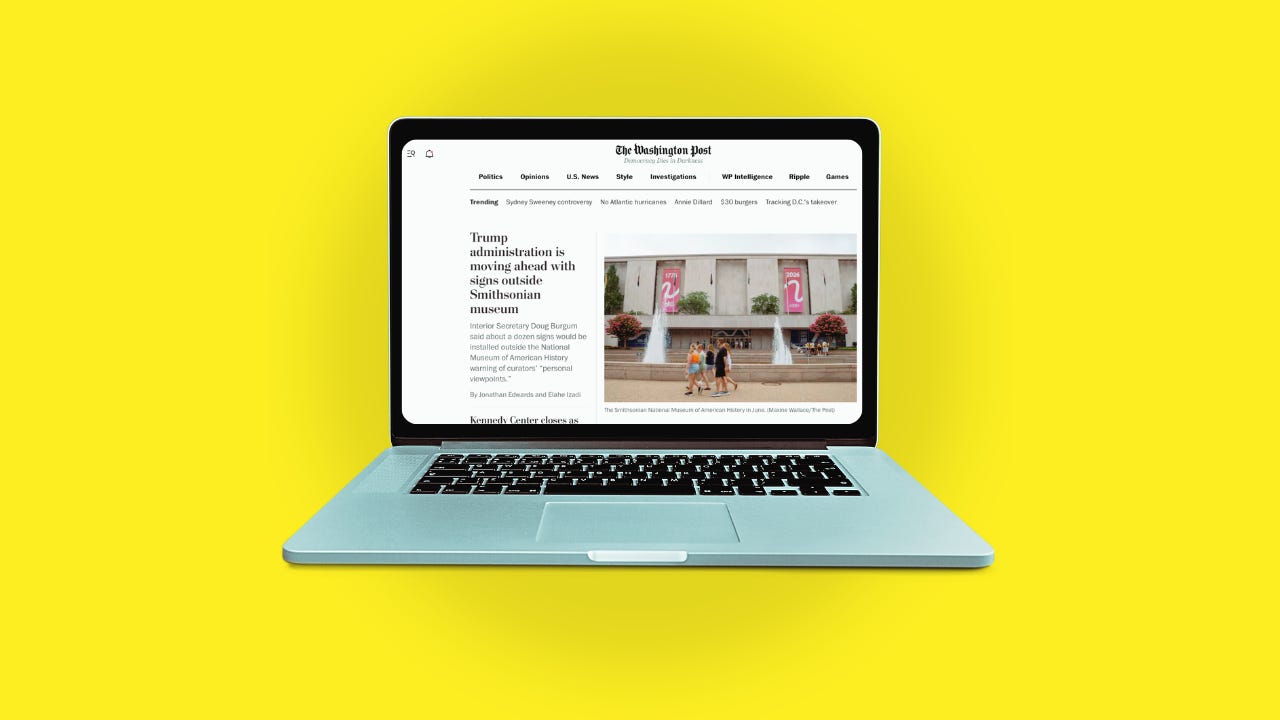
It must be tough to work for the Washington Post these days.
The paper has flushed away tons of credibility since owner Jeff Bezos turned its opinion section into a right-wing chorus line. The news section, though, still breaks important stories. It has done excellent work on the politicization of the Pentagon, Donald Trump’s oil grab in Venezuela, the Reflecting Pool fiasco, and many other stories.
A lot of quality journalists have made the difficult decision to quit the Post. Others have made the difficult decision to stay. News consumers face a similar choice: Is it better to support the strong news gathering at the Post or to refuse to boost the bank account of an owner who is sucking up to a dictator?
CBS News is a different case. While WaPo’s problem is the news side vs. the opinion side, CBS’s problem is worse – it’s news vs. news. Under Trump-friendly ownership and management, some of CBS’ reporting still seems credible, but other stories reek of propaganda, such as the cheap-shotting of Michigan Senate candidate Abdul El-Sayed. A once-respected journalism institution is not to be trusted anymore.
Another institution, the New York Times, comes in for criticism these days because of its political team’s failure to take the Trump threat as seriously as it should. Every time I blast the NYT on social media, I get comments like “Cancel your subscription.” But I’m not urging people to do that. I post about the NYT in hopes that the nation’s most prominent newspaper will do better. We can’t cancel everything. We have to get our news from somewhere.
I feel a special sympathy toward good journalists under bad ownership because I once worked for Rupert Murdoch.
I was 29 years old and needed a job in Chicago so my wife could attend graduate school there. Murdoch had bought the Chicago Sun-Times, a quality tabloid, and the news guild had a contract provision that journalists could claim a generous severance if the paper was sold and they chose to leave. Many did. That created job openings, and I got one as a copy editor.
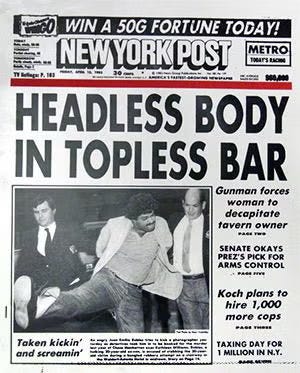
I knew Murdoch’s reputation, but not all of his newspapers were awful. Sure, his New York Post had published this famous front page in 1983:
But Murdoch also owned the Times of London, and he hadn’t ruined that centuries-old publication. This was 12 years before Murdoch invented something called Fox News.
The Chicago Sun-Times of that era had great journalists, including film critic Roger Ebert, and its stories were usually solid. But the front page tended to be obnoxious, with headlines like “ZINC ZAPS COLDS” and heavy promotion of the Wingo sweepstakes.
Murdoch sold the paper after only two years so he could buy a TV station in Chicago without violating the cross-ownership rule. The Sun-Times’ headlines got less garish, but the ownership didn’t get much better. Later on, I worked for a Sun-Times owner worse than Murdoch: Conrad Black. He ended up getting convicted of swindling his company’s shareholders, did three years in prison, wrote a book praising Donald Trump, and – probably not coincidentally – received a Trump pardon.
In my 15 years at the Sun-Times, I rose through the ranks, became Sunday editor, and tried to produce quality work despite the challenges. Black’s underling, David Radler, once told me I should pay attention to the National Enquirer to learn what people wanted to read. And the paper’s editor, Nigel Wade, grew so impatient with my ethical misgivings that he started calling me “the loyal opposition.” It was time to go (or past time), so I took an entry-level job at the Chicago Tribune and eventually made it to metro editor. Ownership and management weren’t perfect there, either, and eventually I asked for a buyout and got it.
So I feel for what the Washington Post staff is going through. And I can see why some of them might think it would be wrong to leave when there’s so much corruption to uncover. That’s the calculation they have to make: Whether they’re doing more good by staying than they would by leaving and no longer lending their credibility to a flawed organization.
As a news consumer, I faced a similar dilemma regarding WaPo: Was it better for me to support the strong newsgathering there or to stop paying money to an oligarch paying tribute to Trump? I eventually dropped my subscription, but I sometimes miss it.
After I left the Tribune, I was website editor for the Medill Local News Initiative at Northwestern University, where we examined ways to combat the ever-growing problem of local news deserts. After a few years, I came to think there was a two-word solution: “good owners.” Which is much easier said than done.
I won’t presume to tell people when to quit their jobs or cancel their subscriptions. My only advice is to be true to yourself and your values. Have a breaking point. If you’re afraid to leave your job, remember that there’s another job out there somewhere. The same goes for news outlets. There are plenty of good ones awaiting your support. Give them a chance.
I can relate, especially to your career arc—but as a reader. Lived in Chicago most of my life; I remember seeing your name in both papers. My breaking point was one week into Murdoch’s ownership; there was some sensationalist story on page 3. As soon as Murdoch sold, I was back. Royko had crossed the street, but it was still a great paper with terrific columnists and sports section. Today it’s a shell of what it was, but I still subscribe, even though I live in NYC.
Like you, NYTimes headlines make me crazy, but still a subscriber. You’re right, it’s a balancing act. The consolation is there’s solid media criticism like yours. That’s a relatively recent development.